E-Squared Magazine
Art + Science | Culture
burko

Tuesday, November 20th, 2018

Art & the Environment: Diane Burko

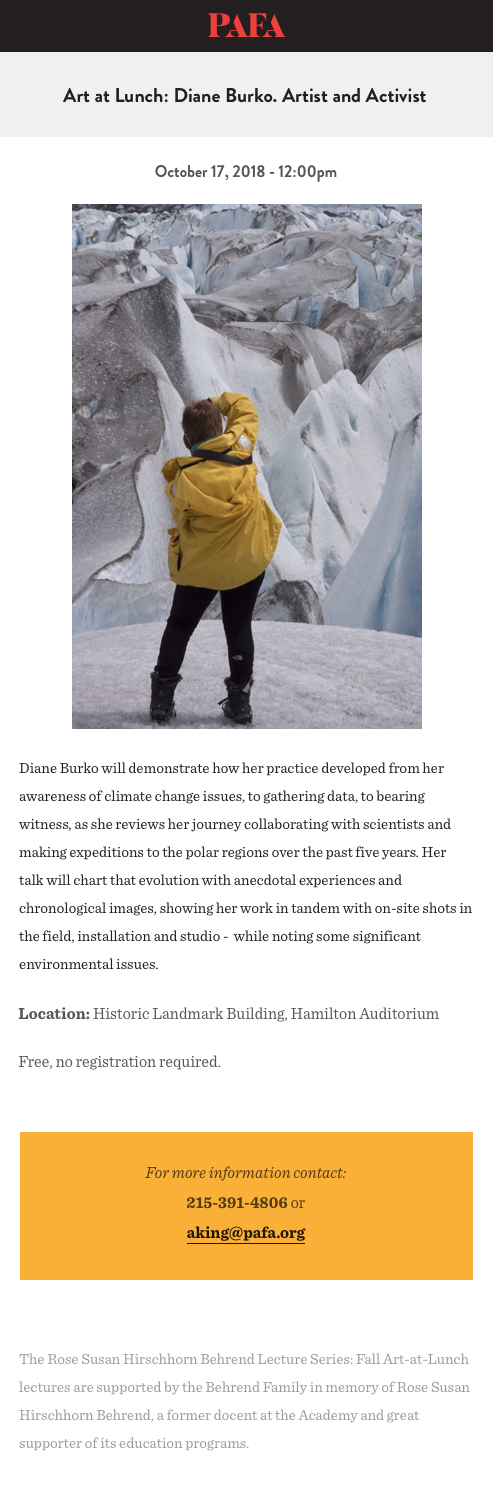
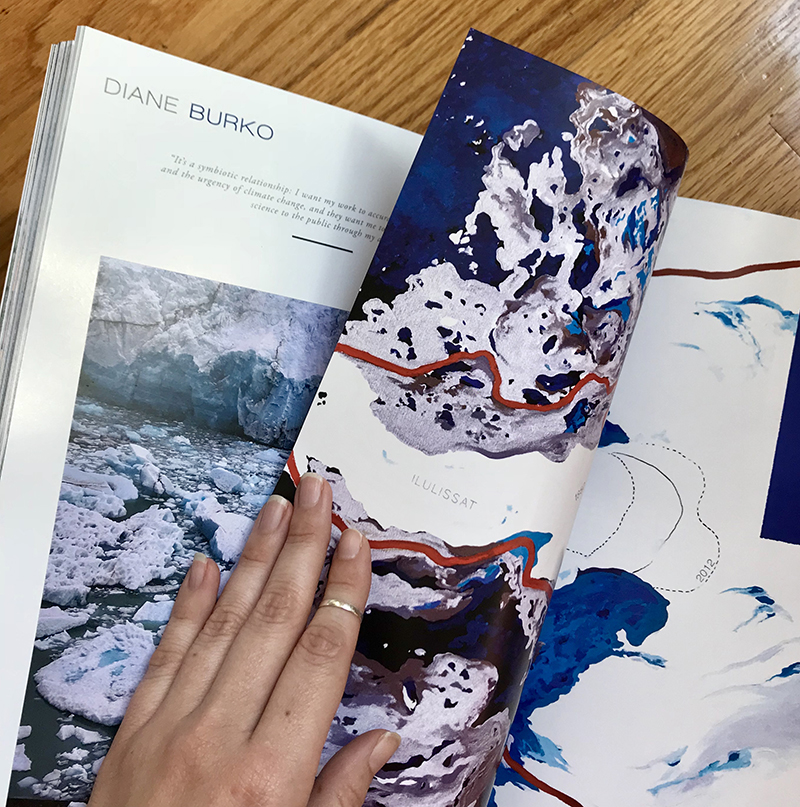
Devoted to communicating issues of climate change for over a decade, Diane Burko [Issue #4] works diligently to document and expose the dramatic disappearance of glaciers.

The process behind her work is quite noteworthy – first immersing herself in the unsettling truths of climate change, witnessing them directly by travelling to sites of glacial decline. Once there, she documents what she sees firsthand through a series of photographs developed in close collaboration with glaciologists.

Burko’s on-site experience enriches and informs not only her work but audiences at her exhibitions that are not necessarily interested in the science and consequences of shrinking ice fields. Her current work reflects expeditions to the three largest ice fields in the world through a series of photographs and paintings. Endangered: from Glaciers to Reefs, will be on display at the National Academy of Sciences until January 31, 2019.


Sunday, November 11th, 2018

Creating a more accurate picture of the world

“The precise center of the Edwardsville miniature Earth is only four thousand miles distant from the real Earth’s center.”–R. Buckminster Fuller, Geoview


While known for many ideas and inventions, R. Buckminster “Bucky” Fuller is most widely revered for his geodesic dome constructions around the world. Fuller was more than an architect though, he was an inventor, theorist, author, and a member of Southern Illinois University faculty from 1960-1974. While at the SIU, Fuller designed a transparent replica of planet Earth for the Center for Spirituality and Sustainability in collaboration with his design partner, Shoji Sadao. The dome first opened in 1971, leaving an indelible mark on the region.

On Friday, Nov. 9 the Center for Spirituality and Sustainability hosted an opening reception to celebrate the opening of the Fuller Dome Gallery located inside the dome. The opening was an especially unusual and intimate experience as Bucky’s daughter, Allegra Fuller Snyder, and his granddaughter, Alexandra May were in attendance.

The event was filled with many speeches and I certainly learned a lot more about the dome and Fuller himself. First, the location of the dome marks a most special one, at the 90th Meridian (west). In the late forties, Fuller proposed a new type of map which he and his partner Sadao termed the “Dymaxion Map.” With the 90th Meridian as its center point, it would convert land and ocean into a 2-D map with minimal distortion. His desire? To create a more accurate picture of the world. In 1946, he received a patent in cartography for the Dymaxion Map. With 28 patents, let us remember Fuller as the inventor that he was.

The gallery also featured an exhibition of Fuller’s art-print portfolio, Inventions: Twelve Around One, with the University Museum, the College of Arts and Sciences and the Meridian Society sponsoring the exhibit. The print-portfolio featured 13 of his most significant inventions and was gifted to the center in 2017 by the Estate of Buckminster Fuller and was accessioned into the SIUE University Museum’s Permanent Collection in cooperation with the SIUE Foundation.


Friday, November 9th, 2018

Celebrating the fall of the Berlin Wall with WHITEvoid

Issue #3 of E-Squared featured light artists WHITEvoid.

Recently we saw LICHTGRENZE, a project that celebrates “25 Years Fall of the Berlin Wall.” The light installation composed of 8000 lit balloons on poles temporarily separates the city for 3 days and nights. Millions of people came to see the helium filled balloons rise to the Berlin night sky at the end of Berlin’s largest outdoor art installation.

You can see their magnificent installation on video here: LICHTGRENZE.

Read more about WHITEvoid in Issue #3 below.

Operating at the interface of art, design, and technology, WHITEvoid was founded in 2004 by Christopher Bauder and is comprised of specialists in interaction design, media design, product design, interior architecture, and electronic engineering. Commissioned by the Festival of Lights Lyon, DEEP WEB is a monumental immersive audiovisual installation and live performance created by light artist Christopher Bauder and composer and musician Robert Henke.

Presented in enormous pitch-dark indoor spaces, DEEP WEB plunges the audience into a ballet of iridescent kinetic light and surround sound. The generative, luminous architectural structure weaves 175 motorized spheres and 12 high power laser systems into a 25-meter-wide and 10-meter-high super-structure, bringing to life a luminous analogy to the nodes and connections of digital networks. Moving up and down, and choreographed and synchronized to an original multi-channel musical score by Robert Henke, the spheres are illuminated by blasts of colorful laser beams resulting in three-dimensional sculptural light drawings and arrangements in cavernous darkness. DEEP WEB brings together decades of separate research and experimentation by two artists with unique visions and passions for sound and light, and by innovative companies working in these fields.

Christopher Bauder has brought his installations and performances to art events and spaces around the world, including Centre Pompidou Paris, MUTEK Montreal, Festival of Lights Lyon, Luminale Frankfurt, The Jewish Museum Berlin, and The National Museum of Fine Arts in Taiwan. He is best known for his city-wide light art installation Lichtgrenze, created in 2014 together with his brother Marc, for the 25th anniversary of the Fall of the Berlin Wall and his large scale kinetic live shows ATOM and GRID, both in cooperation with Robert Henke.

 

Tuesday, October 16th, 2018

Steve Miller & The Billboard Creative


Among numerous other achievements this year, where else can you possibly find Steve Miller?

On a billboard…in Los Angeles…at Melrose and North Hudson. Congratulations to you, Steve Miller, for being selected as an artist for The Bilboard Creative (TBC).

In October, The Billboard Creative will transform 31 Los Angeles billboards into public art spaces, bringing public art to the Los Angeles area. To view all the billboards on an interactive map of their location visit TBC’s website at www.thebillboardcreative.com.

Steve Miller was an artist in E-Squared’s debut issue. You can read more about him below.

New York native Steve Miller is a forerunner of the sci-art movement with his works serving a dual perspective. To the contemporary viewer, Miller’s early work appeared abstract but to the scientist, were realized depictions of biological cells. Since this initial node of ancestry, Miller has continued down the sci-art path, ever-evolving his work.

Miller’s most recent work, The Health of the Planet, investigates and brings attention to the fragility of the Amazon. Depicted through an interdisciplinary approach, Miller makes use of media from X-ray photographs to laminated glass. With the Amazon representing half of the planet’s rainforests and being a biodiversity hotspot, he reminds us through his work how important the forests of the amazon are to our planet.

Steve Miller’s work does not attempt to answer any questions but instead, elicits questions within the viewer. Miller has been exploring the intersection of art and science for well over thirty years and has had over fifty solo exhibitions on display at places like the National Academy of Science and the SciArt Center in New York.

unnamed-1

Monday, October 15th, 2018

Andrew Carnie at the Royal Free Hospital Pathology Museum

Tuesday, October 16th. former artist Andrew Carnie will have an opening exhibition for his body of work, SOMNOTIUM, at the Royal Free Hospital Pathology Museum.

SOMNOTIUM envelops topics regarding the body and sleep with a collision between art, philosophy, and pathology.

The show will be located on the 2nd Floor of the Medical School at Royal Free Campus
[Rowland Hill Street, London NW3 2PF]

We hope you can attend!

Read more about Andrew Carnie of Issue #1 below.

Artist and academic Andrew Carnie explores the inner workings of life and the complexities surrounding what sustains it. In the early stages of his work, Carnie communicates with scientists from different fields regarding his themes and ideas. His work is often time-based in nature, involving slide projections, dissolve systems, or video projected onto complex screen configurations.

Nurturing and tending to, dissolving and diminishing, Carnie’s work engages the viewer in a very intimate way from holding a dissolving heart made of soap to large-scale imagery projections. In a darkened space, layered images appear and disappear on suspended screens, the developing display absorbing the viewer into an expanded sense of space and time through the slowly unfolding narratives that evolve before and around them.

Andrew Carnie’s work is notable as the viewer’s interaction becomes equally important to the meaning of the piece itself. His work has been exhibited at the Science Museum, London, the Natural History Museum, Rotterdam, the Museum of Design in Zurich, Exit Art in New York, among many others. He regularly exhibits and is represented by Robert Devcic at GV Art Gallery London and by Mark Segal at The Artists Agency.

Monday, October 15th, 2018

Mauro Perucchetti: From Pop Art to Psychedelic Colors

Congratulations to previous artist, Mauro Perucchetti, for his recent interview with Wall Street International Magazine!

Perucchetti appeared in Issue #3 of E-Squared Magazine which explored themes of power, destruction, and modification. Read more about him in Issue #3 below.

Redolent of pop art days, Italian artist Mauro Perucchetti creates work that does not just carry with it bright and fun colors but a hard-edged statement regarding many of the deleterious aspects of our modern day society and culture. Perucchetti typically works on a large-scale and primarily in the medium of pigmented resin that he has seamlessly perfected over the years.

Pulling the viewer in with minimalistic forms and vibrant colors, Mauro Perucchetti’s work succeeds in catching the viewer’s attention. Upon further assessment, one can begin to tease apart his often ironic symbolism pertaining to mass consumerism, delusions created through technology, codes of conduct, statements of political relevance, among numerous other moral issues. From afar works like Jelly Baby Cross: Cloning and Religion, appear as a sleek, color-flecked cross, but stepping closer, the viewer soon sees that the cross is filled with his famous jelly babies, thus provoking a conversation about religion and cloning. Other works like AK47 are more apparent in their meaning but the candied appearance of such weaponry leaves the viewer in a state of paradoxical contemplation.

As pop art originally stood to make a declaration of disinterest towards social issues, Mauro Perucchetti flips this attitude entirely upside down with his work, lending to a potentially new art movement – that of “moralizing” pop art. Perucchetti lives in London with his wife and actively exhibits his artwork around the world. His installations can be found in public and private collections from Bill & Melinda Gates to the Louvre in Paris.


Sunday, October 7th, 2018

Diane Burko: Artist & Activist

pafa-art-at-lunch-announcementimg_4901Issue #4 artist & activist Diane Burko will soon be making a presence at the Pennsylvania Academy of Fine Arts for her talk and signing for her latest book, Endangered: From Glaciers to Reefs.

Published in conjunction with her current exhibit at the National Academy of Sciences in DC, the book details her practice spanning data collection to bearing witness first hand the effects of climate change.

Burko’s work is incredibly vital to the underlying message that Issue #4 attempts to address: that of destruction, but hope in restoration.


The event will be held on October 17–we hope you can make it!


Thursday, September 20th, 2018

Elizabeth Jameson on Rediscovering Intimacy without Touch

A big congrats to previous artist Elizabeth Jameson for her piece in The New York Times!

Jameson appeared in E-Squared Magazine’s debut issue which explored themes of the animal and what it means to be human. Read more about her in Issue #1 below.

Elizabeth Jameson’s work lives at the intersection of science, art, and technology. She uses emerging forms of neuro-technology to make images accessible to people living with brain disease and to the public in general. Her role as an artist is to explore and apply technology in such a way that provokes conversations about living with a disease. She focuses on brain scans, particularly Magnetic Resonance Imaging (MRI), considering them one of the primary symbols of Multiple Sclerosis (MS). Through personal experience, Jameson understands the visual impact of MRI well as she was diagnosed with MS many years ago. Undergoing numerous brain scans to track the progression of her disease, she developed a deep fascination with the architecture of the brain and began focusing her art practice on reinterpreting these frightening yet mesmerizing images.

Jameson’s images serve as a starting point to describe the ever-changing experience of living with a progressive disease. She begins her work with medical imaging that provides an intimate view of the brain’s interior structure. She describes how the medical images show a naked brain, without the context of human emotions and feelings and attempts to reclaim the MRI through printmaking, adding color and elements of design to disrupt the unsightliness of her brain lesions. Through the new imagery she generates, Jameson allows a view of the brain that combines beauty and complexity.

Vibrant in color, Elizabeth Jameson’s compositions provide a mood that changes the discourse with herself and her body.  Her work is shown internationally and can be found in permanent collections like the National Institute of Health (NIH), Stanford University, Yale University, The Center for Brain Science at Harvard University, Johns Hopkins University, and the Center for Art and Brain at the University of California, Davis. In addition, Jameson’s work has been featured as cover art in numerous scientific publications such as Neurology, the Journal of the American Academy of Neurology and Oxford University Press.

Sunday, September 9th, 2018

Still Life by Eric Wert

Cover Image: Eric Wert. Detail of: Citrus. 2012. Oil on Panel. 24 x 24 in.

Issue #3 artist Eric Wert has been exhibiting his work nationally and internationally since 1998. His work has been published in numerous magazines like Visual Feast, American Arts Quarterly, Art New England, Hi Fructose, among others. Wert now has a book titled Still Life that is set for release on September 13th. The book can be purchased at Powell’s City of Books who will also be hosting a release party for him on the evening of Thursday, September 13th. (7:30 P.M.). E-Squared is very excited to receive our pre-ordered copy!

ISSUE #3

Still life paintings of fruit and vegetables have never appeared so provocative in the work of Eric Wert. Attracted to rigorous accuracy and representation, he began his career as a scientific illustrator, but he found the technical aspects of the field left him desiring more. Paving a different path for himself, he decided to express his subjects more vividly, bringing them to a new life of their own. Characterized by vibrantly colored subjects contrasted against subdued ornate backdrops, Eric Wert’s oil paintings generate a feeling of intensity. Reflections of the subjects themselves and details of water drops or nectar often fill the foreground, telling a complex narrative of beautiful destruction. The vibrancy of the fruit in Blood Oranges set against the passive hues of exquisite fabric induce a feeling of energetic tension. Attention to detail combined with the expressive features of Wert’s work leaves the viewer waiting for the next drop of nectar to drip or glass vase to tumble – a true testament to his immense skill in creating such hyper-realistic renderings.

PUBLISHER COMMENTS 

Eric Wert’s flowers, fruits, and vegetables are the stuff of a florist’s or farmer’s perfection — objects of incomparable beauty, hyperrealistic, radiant, and arranged in a tumult that’s filled with life. Within this bounty, the artist also recognizes the realities of the garden, forest, and field: snails, slugs, and ants; ladybugs, bees, and butterflies; leaves that decay, petals that fall, fruits that bruise, and vegetables that scar. These things come from the soil and, given time, there they will return with the rest of us. What remains beyond everything is the painting.

Sunday, September 9th, 2018

Further Delays with Issue #4

Today, I am deeming Issue #4 as the challenge issue. Here are some of the hurdles in attempting to release this issue:

1. Moving E-Squared over 1200 miles

2. Losing our printer

3. Having to find a new printer

4. Being over-budget with our new printer

5. Reception of a coverless Issue #4

Yes, you read that right, Issue #4 was printed without covers. Our printer has admitted to the mistake and they are correcting this issue as I write this to you.

Please, for me, hold on for one more day (or two or three…). On the bright side, outside of being coverless, Issue #4 is magnificently beautiful inside!

Pre-orders are still open for Issue #4–you can snag another copy here.

Questions? E-mail me directly at emily.dustman@gmail.com

Thank you SO MUCH for your patience,

Emily A. Dustman
Founder & Creative Director
E-Squared Magazine

“Resilience isn’t a single skill. It’s a variety of skills and coping mechanisms. To bounce back from bumps in the road as well as failures, you should focus on emphasizing the positive.”––Jean Chatzky

img-4273

Category Archives: Uncategorized

Art & the Environment: Diane Burko

Devoted to communicating issues of climate change for over a decade, Diane Burko [Issue #4] works diligently to document and expose the dramatic disappearance of glaciers. The process behind her work is quite noteworthy – first immersing herself in the unsettling truths of climate change, witnessing them directly by travelling to sites of glacial decline. Once there, […]

Creating a more accurate picture of the world

“The precise center of the Edwardsville miniature Earth is only four thousand miles distant from the real Earth’s center.”–R. Buckminster Fuller, Geoview   While known for many ideas and inventions, R. Buckminster “Bucky” Fuller is most widely revered for his geodesic dome constructions around the world. Fuller was more than an architect though, he was an […]

Celebrating the fall of the Berlin Wall with WHITEvoid

Issue #3 of E-Squared featured light artists WHITEvoid. Recently we saw LICHTGRENZE, a project that celebrates “25 Years Fall of the Berlin Wall.” The light installation composed of 8000 lit balloons on poles temporarily separates the city for 3 days and nights. Millions of people came to see the helium filled balloons rise to the Berlin night […]

Steve Miller & The Billboard Creative

  Among numerous other achievements this year, where else can you possibly find Steve Miller? On a billboard…in Los Angeles…at Melrose and North Hudson. Congratulations to you, Steve Miller, for being selected as an artist for The Bilboard Creative (TBC). In October, The Billboard Creative will transform 31 Los Angeles billboards into public art spaces, bringing public […]

Andrew Carnie at the Royal Free Hospital Pathology Museum

Tuesday, October 16th. former artist Andrew Carnie will have an opening exhibition for his body of work, SOMNOTIUM, at the Royal Free Hospital Pathology Museum. SOMNOTIUM envelops topics regarding the body and sleep with a collision between art, philosophy, and pathology. The show will be located on the 2nd Floor of the Medical School at Royal Free […]

Mauro Perucchetti: From Pop Art to Psychedelic Colors

Congratulations to previous artist, Mauro Perucchetti, for his recent interview with Wall Street International Magazine! Perucchetti appeared in Issue #3 of E-Squared Magazine which explored themes of power, destruction, and modification. Read more about him in Issue #3 below. Redolent of pop art days, Italian artist Mauro Perucchetti creates work that does not just carry with it […]

Diane Burko: Artist & Activist

Issue #4 artist & activist Diane Burko will soon be making a presence at the Pennsylvania Academy of Fine Arts for her talk and signing for her latest book, Endangered: From Glaciers to Reefs. Published in conjunction with her current exhibit at the National Academy of Sciences in DC, the book details her practice spanning data collection to bearing […]

Elizabeth Jameson on Rediscovering Intimacy without Touch

A big congrats to previous artist Elizabeth Jameson for her piece in The New York Times! Jameson appeared in E-Squared Magazine’s debut issue which explored themes of the animal and what it means to be human. Read more about her in Issue #1 below. Elizabeth Jameson’s work lives at the intersection of science, art, and technology. She uses emerging forms […]

Still Life by Eric Wert

Cover Image: Eric Wert. Detail of: Citrus. 2012. Oil on Panel. 24 x 24 in. Issue #3 artist Eric Wert has been exhibiting his work nationally and internationally since 1998. His work has been published in numerous magazines like Visual Feast, American Arts Quarterly, Art New England, Hi Fructose, among others. Wert now has a book titled Still Life […]

Further Delays with Issue #4

Today, I am deeming Issue #4 as the challenge issue. Here are some of the hurdles in attempting to release this issue: 1. Moving E-Squared over 1200 miles 2. Losing our printer 3. Having to find a new printer 4. Being over-budget with our new printer 5. Reception of a coverless Issue #4 Yes, you read that right, Issue […]